In a civil engineering laboratory, a sieve is much more than just a “strainer.” It is a precision measuring instrument. Whether you are analyzing the particle size distribution of soils or aggregates, the accuracy of your results depends directly on the condition of your wire mesh.
However, cleaning is often the most neglected step. Poor maintenance opens the door to clogging, mesh deformation, and ultimately, distorted results.
Here are some best practices for maintaining your control screens in accordance with current standards.
1. Why is it so important to clean?
A poorly cleaned sieve presents two major risks:
- Clogging: Particles become trapped in the openings, reducing the screening area and distorting the particle size distribution curve.
- Premature wear: Residues from abrasive or corrosive materials attack the stainless steel mesh
2. The gentle method: Manual cleaning
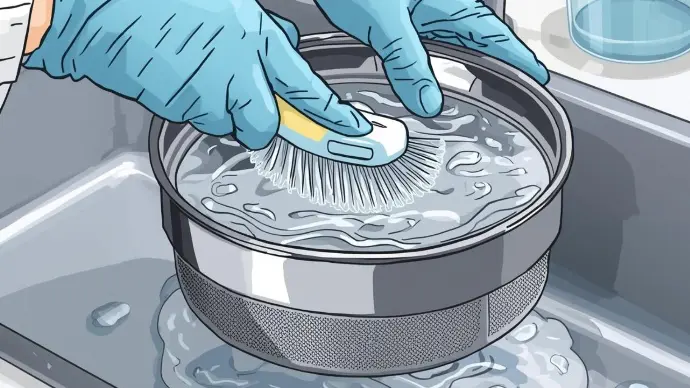
After each test, light cleaning is necessary. But be careful not to use too much force!
- To do: Use a nylon or natural bristle brush (soft for fine mesh) or a brass brush (only for coarser mesh, > 1 mm). Always brush from the underside of the fabric using light circular movements.
- Do not: Never use a sharp object (needle, screwdriver) to remove a stuck particle. This will spread the threads of the fabric and render the screen non-compliant.
3. The ultimate solution: Ultrasonic bath
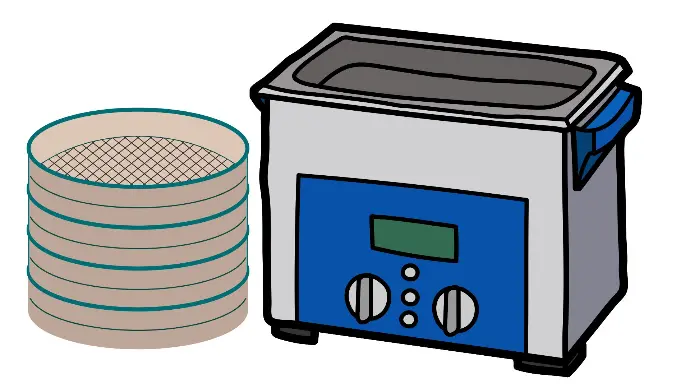
For thorough cleaning without risk of deformation, the ultrasonic tank is the most cost-effective investment for a laboratory.
- The principle: The waves create cavitation bubbles that dislodge even the finest particles in inaccessible corners.
- CTRMAT advice: Use a non-corrosive cleaning solution and do not stack the screens in the tray to allow for even wave diffusion.
4. Washing and drying: Precautions
If you are performing wet sieving:
- Wash in warm water with a neutral detergent.
- Drying: Never exceed 80°C (ideally 50°C). Excessive heat can cause thermal expansion, which irreversibly stretches the fabric.
- Check that there is no residue in the groove between the canvas and the frame.
5. Compliance control
Cleaning is the ideal time to inspect your tools. A screen should be replaced if:
- The mesh has tears or holes.
- The mesh is “warped” or stretched
- The calibration certificate has expired
Expert tip: “Identify your screens with a color code or clear marking. A screen dedicated solely to clay soils will last longer if it is not mixed with equipment used for abrasive aggregates.”
Conclusion
Taking five minutes to clean your equipment properly saves hundreds of dollars in premature replacement costs and ensures the accuracy of your test reports.
Need to replace your sieving equipment? Discover our complete range of stainless steel sieves that comply with EN ISO standards at www.ctrmat.fr/shop/tamis-315-mm-h-77-mm-d-analyse-granulometrique-toile-tissee-663?page=2&search=tamis#attr=280,670,671,672.