In the construction and civil engineering sectors, the quality of concrete or asphalt depends on a factor that is invisible to the naked eye: the propriety of the sand. The excessive presence of fine clay particles can compromise the adhesion of binders and the final strength of the structure
The Sand Equivalent (SE) test is the standard test for measuring this degree of clarity. Here is everything you need to know to perform a successful test.
1. Why Sand equivalent test is essential?
The sand used in construction must not be “contaminated” by fine dust or clay. These impurities absorb water and cement, causing:
- A decrease in mechanical strength.
- An increased risk of cracking.
- Poor resistance to frost.
The test quantifies the ratio between the sandy (valuable) part and the fine (harmful) part.
2. The principle of the test (Standard NF EN 933-8)
The test consists of separating the fine elements of the sand in a cylindrical test tube by flocculation. A specific washing solution is used for this purpose.
The 4 key steps of the process:
- Refill: Add the cleaning solution and the sand sample (sifted through a 2 mm sieve) to the test tube.
- Agitation: This is the crucial step. The test tube is agitated (manually or using an automatic agitator) to detach the fines from the sand grains.
- Washing & Resting: Fill the level with the solution via the washing tube, then let it rest for exactly 20 minutes.
- Measurement: Measure the height of the sand deposit (h2) and the total height (sand + fine flocculate, h1).
3. Calculating the Sand Equivalent
The result is expressed as a percentage according to the following formula:
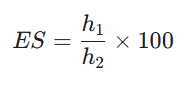
- ES > 80: Very clean sand (perfect for high-quality concrete).
- 70 < ES < 80: Clean sand (normal use).
- ES < 60: Clayey sand (risk of poor quality, often requires industrial washing).
4. Common mistakes to avoid in the lab
To ensure the repeatability of your measurements, pay attention to the following points:
- Room temperature: Ideally, it should be between 20°C and 25°C. Temperature variations alter the viscosity of the solution and distort sedimentation.
- Stirring: Manual stirring is a source of human error. Using an electric stirrer (compliant with the standard) guarantees constant energy.
- The cleaning solution: Do not prepare too large quantities in advance; the solution may lose its effectiveness after a few weeks.
5. Necessary equipment (CTRMAT checklist)
To perform this test properly, you'll need:
- Transparent graduate cylinders with stoppers.
- Calibrated measuring piston.
- Concentrated washing solution.
- Test tube shaker (highly recommended for accuracy).
- High-precision stopwatch.
Conclusion
The sand equivalent test remains the simplest and quickest way to validate the conformity of a material on site or in a quarry. Well-maintained equipment and a rigorous procedure are your best guarantees against technical disputes.
Retrouvez tout le kit complet pour l'essai d'équivalent de sable sur https://www.ctrmat.fr/shop/category/granulat-equivalent-de-sable-108 De la solution lavante à l'agitateur automatique, nous équipons votre laboratoire avec du matériel certifié.