The relationship between dry density ( ) and compaction energy (number of blows) are fundamental in geotechnical engineering to ensure the validity of a permeability test. If the soil is not compacted according to the specifications of the reference Proctor test, the permeability value (k) obtained will be incorrect.
1. The Energy/Density Correlation
The dry density of soil in the permeameter mold depends directly on the specific compaction energy (E), defined by the formula:
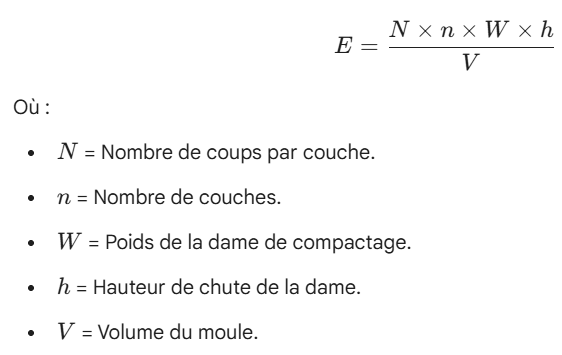
The principle: The more you increase the number of blows (N), the more you reduce the void ratio (e). Since permeability k is extremely sensitive to the void ratio, a slight variation in dry density causes a major variation in hydraulic conductivity (often by a factor of 10 or 100).
2. Why is this crucial for the permeability test?
During laboratory testing, the aim is generally to reproduce the in-situ density of the construction site (often 95% or 98% of the Normal Proctor Optimum).
- Undercompaction (too few blows): The soil remains too porous. Water flows too quickly, overestimating the actual permeability. Risk of sample settlement during the test.
- Over-compaction (too many blows): You risk breaking the grains (for fragile materials) or creating a structure that is too dense and does not correspond to the reality of the terrain.
3. How do you determine the number of strokes?
To achieve the desired dry density  In your permeability mold, you must refer to your preliminary Proctor curve:
- Identify the reference energy: If the OPN (Optimum Proctor Normal) is 25 blows per layer in a Proctor mold, and your permeameter mold has a different volume, you must adjust N to maintain the same volumetric energy (E).
- Moisture adjustment: Maximum dry density is only achieved if the soil is at its optimum water content.
 If you compact dry soil, even with many blows, you will never achieve high density.
4. The importance of compaction for your permeability tests
To obtain a representative permeability value (k), compaction in the mold must be rigorous. A variation of only 1% in dry density can significantly alter your permeability result.
Our recommendations:
- Use a standardized compaction tamper (normal or modified Proctor) to ensure consistent energy.
- Always check the mass of soil introduced and the final volume to calculate the actual dry density obtained after compaction.
- Ensure that you compact in several layers of equal thickness for perfect homogeneity of the test specimen.
💡 The CTRMAT tip
To facilitate your testing, use our rigid-walled permeability molds, whose dimensions are compatible with standard compaction plates. This allows you to apply standard compaction energies directly without complex conversion calculations.
Technical FAQs
- Can low moisture content be compensated for by increasing the number of strokes? No, beyond a certain threshold, the additional energy breaks the grains without increasing the density.
- Why does permeability drop so quickly with density? Because compaction reduces the “large” pores that are the preferred pathways for water.
- What is the energy of a standard Proctor test? It is approximately 593,200.
 (Joules per cubic meter).